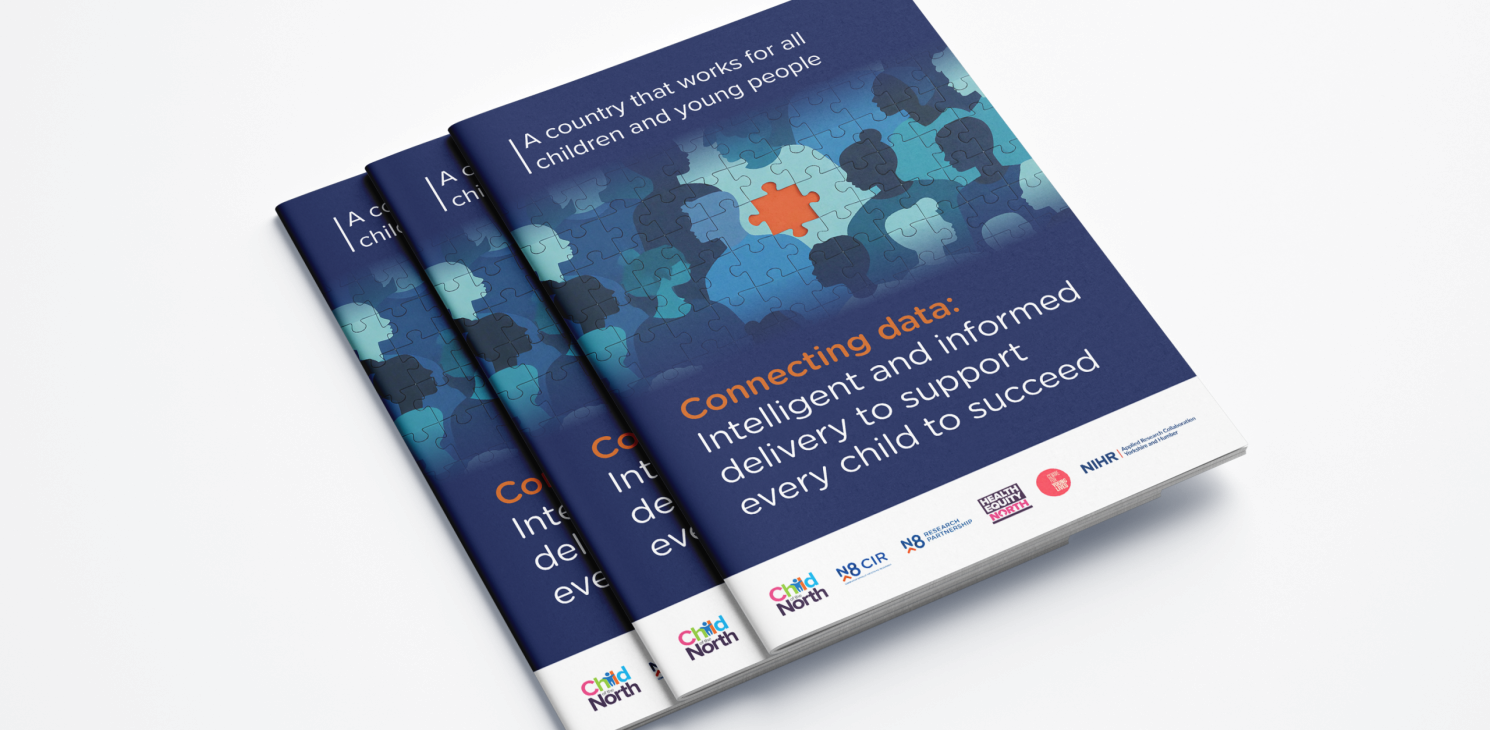
A new report shows how proven approaches already working in Northern England can be scaled nationally to address the urgent need for better data sharing across children’s services.
Published by Child of the North and partners, the new ‘Connecting data: Intelligent and informed delivery to support every child to succeed’ report provides a clear case for a national devolved approach to connected data.
The report reflects consensus across researchers, policymakers, public service leaders and practitioners and warns that children are being left unsupported, unseen and exposed to avoidable harm because services do not safely and lawfully share and link the information they already hold. It argues that effective data sharing, enabled by connected data infrastructure, is “literally a matter of life and death”. The report identifies a major national opportunity to strengthen public services, accelerate research and drive economic growth whilst retaining data sovereignty.
The report builds on a Manchester workshop held earlier this year, which brought researchers from across the North of England together with policy teams and scientists from across Whitehall to discuss connected data practices and opportunities, with a particular focus on Special Educational Needs and Disabilities (SEND).
Challenges in children’s lives span health, education, social care and wider family circumstances, but services and systems continue to operate in silos. The report highlights how the disconnect makes it harder to identify vulnerability early, coordinate support, and prevent escalation.
The report highlights the urgent need for a new approach to connecting data, drawing on previous analyses conducted by Child of the North and the Children’s Commissioner:
- More than 2 million children in England live in families facing complex needs
- 760,000 vulnerable children were seen by children’s services but received no formal support, while another 830,000 were not even on the radar of services.
- In 81% of serious incidents where a child died or suffered serious harm, lack of coordination between services was driven by poor information sharing, delayed responses and fragmentation.
The report highlights that poor connection between public services remains a persistent challenge. It argues that the challenge is not a lack of data, but a lack of a firm political commitment until now to use the infrastructure, mandates, governance, and delivery models that would allow data to be used safely and meaningfully across organisational boundaries.
The report sets out a clear solution and calls on the government to adopt a national “Connected ICB (Integrated Care Board)” model, using NHS infrastructure to link data across health, education, social care and other services. Crucially, this is not a single central database, but a devolved model where local systems (and communities) retain control of their data while contributing to a connected national ecosystem that enables shared learning, improved services, and stronger evidence for improving the health of children.
The report concludes that:
“The goal is not a single central database, but an interconnected ecosystem in which trusted local systems generate insight, improve services, and support research and innovation at national scale.”
The report draws on real-world examples, including Connected Bradford, which has demonstrated how linked data across health, education, social care and policing can reveal patterns of need across populations, support earlier intervention, improve coordination between services, and enable research and evaluation at scale. These examples show that connected data can be delivered safely, lawfully and with public trust when a devolved model is adopted.
The report highlights a significant opportunity for the UK. Connected data infrastructure is described as “an asset for science, innovation, and economic growth.” A national model could strengthen the UK’s position as a leader in data-driven research and public service innovation, while improving outcomes for children and families.
The report stresses the current costs of treating symptoms late rather than addressing causes early and argues that connected data for connected services safeguards the sustainability of the state, the cohesion of communities, and the path to enduring national prosperity while retaining data sovereignty.
Its ten recommendations include a national mandate for lawful data linkage, a Connected ICB programme, long-term investment, trusted governance, practical frontline information sharing, education as a full partner, and stronger accountability for shared outcomes.
The authors urge the government to move from isolated local innovation to a nationally backed, regionally delivered model for connected data. This should begin with children and families, given the cross-cutting nature of their needs. The evidence, expertise and practical examples already exist; what is now needed is the leadership, investment and mandate to scale what works.
The report makes clear that connected data is not a technical upgrade but a foundational shift in how public services operate.
The report states:
“Connected data must be seen as core public-service infrastructure: essential if we are serious about prevention, earlier intervention, public trust and better outcomes.”
Without it, the report warns, the government will continue to respond to problems too late and with only partial visibility.
Haroon Chowdry, Chief Executive of the Centre for Young Lives, said:
“Children’s lives don’t fit neatly into the silos that services are built around. Whether it’s education, healthcare or child protection, if services can’t see the full picture then children fall through the gaps, and opportunities to help them are missed. This means worse outcomes, wasted potential and sometimes devastating harm.This report shows that the solutions already exist. Connected data can transform how we identify the needs of children and families, enabling better and earlier support – not just keeping children safe, but also delivering a better deal for children, public services and the economy. If the next Prime Minister wants to ensure all young people can do well, they must seize this moment to break up the silos holding back public services. Now is the time to be much more ambitious about using connected data to boost life chances for all children, wherever they are growing up.”
Professor Steve Turner, President of the Royal College of Paediatrics and Child Health said:
“The shift from analogue to digital is key to helping the Westminster government achieve their ambition to raise the healthiest generation ever. By connecting data safely across health, education and other children’s services, we can identify need earlier, intervene sooner and help ensure every child, regardless of where they grow up, has the opportunity to thrive.”
Dr Mike McKean, Vice President for Policy, Royal College of Paediatrics and Child Health said:
“Far too many children growing up in our most deprived communities experience worse health and poorer life chances simply because of where they live. Whether through an increased risk of obesity, tooth decay, respiratory conditions caused by poor housing and air pollution, or delayed access to the care and support they need, these stark health inequalities are unacceptable.”
Dr Camilla Kingdon, Paediatrician and former President of the Royal College of Paediatrics and Child Health said:
“As an NHS paediatrician I have learnt that so much of children’s health and wellbeing lies beyond our health services. If we genuinely want to improve the life chances of all children in this country and put their futures onto a secure footing, it is imperative that we are able to see the whole picture – not just through one narrow lens. All the services involved in supporting our children need to be linked and we know from groups like Born in Bradford how this can be done safely and put to critically important use to help children flourish. Now is the time for action.”
Professor Mark Mon Williams, Director of the Born in Bradford Centre for Applied Education Research said:
“The UK has a remarkable opportunity to harness its data assets in an ethical way that directly benefits all children and young people and places the UK at the vanguard of the data and AI revolution sweeping the world. The Child of the North model shows how the UK can control its destiny and grow its economy by leveraging our existing assets, including the NHS, by adopting a regionally devolved approach to connecting data.”
This report is a collaborative programme of work between Child of the North, N8 Computationally Intensive Research, and the Centre for Young Lives, with the support of the Royal College of Paediatrics and Child Health and the NIHR Applied Research Collaboration Yorkshire and Humber, and contributions from researchers, policymakers and practitioners across the North of England and beyond.