Child of the North campaign – A country that works for all children and young people
We are calling on the government to put children first. Our 2024 report series provides evidence-based plans and recommendations on how to improve outcomes for children and young people in the North of England and beyond. Published alongside 2025 report updates, our practitioner toolkits are designed to support schools, child health services, and local authorities to implement the report recommendations and put children first. #ChildrenFirst
A Children First Government
There are record numbers of children in care, millions of children experiencing poverty and hardship, there is an exam attainment gap that remains stubbornly high, and an education system where one in five young people are leaving education without basic qualifications. Thousands of children are starting school already way behind in their social development and there is a children’s mental health and wellbeing crisis.
Child of the North and the Centre for Young Lives believe it doesn’t need to be this way.
We want the government to prioritise its work to focus on improving every aspect of childhood.
2024 – 2025 report series and #ChildrenFirst campaign
A country that works for all children and young people
Throughout 2024 and into early 2025, we jointly published a series of twelve reports showing how putting the interests and life chances of children and young people (CYP) at the heart of policymaking and delivery is crucial to Britain’s future.
The reports shine a light on some of the biggest challenges facing government as identified by health leaders, including reducing child poverty and improving support for CYP with mental health conditions. They also provide rigorous research and pragmatic, evidence-based recommendations which acknowledge the ongoing financial limitations on government spending.
The reports demonstrate the capacity of universities and research institutions to provide evidence-based recommendations and suggest actions that could and should be taken by every part of the system to create the changes so desperately needed throughout the UK.
We launched our report Education Equity for the North of England: Challenges & Opportunities, at the National Opportunity Summit in Leeds on Monday, 8 September 2025. The report calls for children’s wellbeing, development and readiness for school to be a national priority.
Alongside the release of this report we announced the launch of our twelve-week #ChildrenFirst campaign to ensure alignment between practitioners on the ground and the government’s work on the Opportunity Mission. The campaign provided updates to our original report series ‘A country for all children and young people’, as well as new practitioner toolkits to support education colleagues, child heath colleagues and local authority colleagues to turn evidence into action.
The #ChildrenFirst campaign calls on the government, policymakers, practitioners, academics, communities and young people to work together to build a country that works for all children and young people.
2026
On the day the government published its Every child achieving and thriving white paper on reforms to the schools and SEND systems in England, policymakers, researchers, clinicians and frontline practitioners gathered in Manchester to demonstrate how connected data can turn that ambition into reality. The Child of the North Data Showcase, delivered in partnership with N8 Computationally Intensive Research and Northern Health Science Alliance brought together nearly 100 delegates from NHS trusts, local authorities, universities, and the voluntary sector to examine how linking data across education, health, and social care can get children with Special Educational Needs and Disabilities the support they need earlier, and more effectively.
On 10 July 2026, the resulting report ‘Connecting data: Intelligent and informed delivery to support every child to succeed’ was published. The report sets out the urgent case for a national approach to connected data across children’s services, and provides the government with ten recommendations on how to move from isolated examples of good practice to a coherent national approach.
 |
An evidence-based plan for addressing the autism assessment and support crisisPublished February 2024 The first report in a twelve part series – produced jointly by Child of the North and the Centre for Young Lives – that seeks to deliver a country that works for all children and young people, sets out a new plan to support autistic children. In September 2025, a report update was released alongside guidance for education colleagues, child heath colleagues and local authority colleagues. |
|
 |
An evidence-based plan for addressing poverty with and through schoolsPublished March 2024 The second report in a twelve-part series – produced jointly by Child of the North and the Centre for Young Lives – that seeks to deliver a country that works for all children and young people, sets out a new plan for addressing poverty with and through schools. In September 2025, a report update was released alongside guidance for education colleagues, child heath colleagues and local authority colleagues. |
|
 |
Improving mental health and wellbeing with and through educational settingsPublished April 2024 The third report in a twelve-part series – produced jointly by Child of the North and the Centre for Young Lives – that seeks to deliver a country that works for all children and young people, sets out a new plan for Government to boost children’s mental health through schools. In September 2025, a report update was released alongside guidance for education colleagues, child heath colleagues and local authority colleagues. |
|
 |
Building the foundations of a new ‘Sure Start’: An evidence-based plan for connecting and coordinating support and services in and around education settingsPublished May 2024 The fourth report in a twelve-part series – produced jointly by Child of the North and the Centre for Young Lives – that seeks to deliver a country that works for all children and young people, sets out the case for a new updated model of Sure Start that puts schools and nurseries at its heart. In October 2025, a report update was released alongside guidance for education colleagues, child heath colleagues and local authority colleagues. |
|
 |
An evidence-based plan for supporting physical activity and healthy nutrition with and through education settingsPublished May 2024 The fifth report in a twelve-part series – produced jointly by Child of the North and the Centre for Young Lives – that seeks to deliver a country that works for all children and young people, calls for schools to be supported to fix the broken school food system and tackle Britain’s child obesity crisis. In October 2025, a report update was released alongside guidance for education colleagues, child heath colleagues and local authority colleagues. |
|
 |
An evidence-based plan for addressing the special educational needs and disabilities (SEND) assessment and support crisisPublished July 2024 The sixth report in a twelve-part series – produced jointly by Child of the North and the Centre for Young Lives – that seeks to deliver a country that works for all children and young people, reveals the scale of the crisis facing many children and young people with special educational needs and disabilities. In October 2025, a report update was released alongside guidance for education colleagues, child heath colleagues and local authority colleagues. |
|
 |
An evidence-based plan for upskilling our children and young people for digital futuresPublished August 2024 The seventh report in a twelve-part series – produced jointly by Child of the North and the Centre for Young Lives – that seeks to deliver a country that works for all children and young people, puts forward new proposals and highlights innovations to close a digital divide which is holding back the life chances of millions of children in the UK, and to enable them to navigate digital content critically and responsibly. In October 2025, a report update was released alongside guidance for education colleagues, child heath colleagues and local authority colleagues. |
|
 |
An evidence-based plan for improving children’s oral health with and through educational settingsPublished September 2024 The eighth report in a twelve-part series – produced jointly by Child of the North and the Centre for Young Lives – that seeks to deliver a country that works for all children and young people, makes a series of new proposals to tackle the children’s oral health crisis in England which is seeing millions of children suffering from tooth decay. In October 2025, a report update was released alongside guidance for education colleagues, child heath colleagues and local authority colleagues. |
|
 |
An evidence-based approach to supporting children in the preschool yearsPublished October 2024 The ninth report in a twelve-part series – produced jointly by Child of the North and the Centre for Young Lives – that seeks to deliver a country that works for all children and young people, makes a series of proposals to tackle the high number of children starting school not ‘school ready’, and the crisis in early years and childcare provision – particularly in disadvantaged areas. In November 2025, a report update was released alongside guidance for education colleagues, child heath colleagues and local authority colleagues. |
|
 |
An evidence-based plan for improving school attendancePublished October 2024 The tenth report in a twelve-part series – produced jointly by Child of the North and the Centre for Young Lives – that seeks to deliver a country that works for all children and young people, puts forward new recommendations to tackle the school absence crisis. In November 2025, a report update was released alongside guidance for education colleagues, child heath colleagues and local authority colleagues. |
|
 |
An evidence-based plan for addressing childhood vulnerability, crime and justicePublished November 2024 The eleventh report in a twelve-part series – produced jointly by Child of the North and the Centre for Young Lives – that seeks to deliver a country that works for all children and young people, sets out an evidence-based plan to protect and support the thousands of vulnerable children in England at risk of involvement with the criminal justice system. In November 2025, a report update was released alongside guidance for education colleagues, child heath colleagues and local authority colleagues. |
|
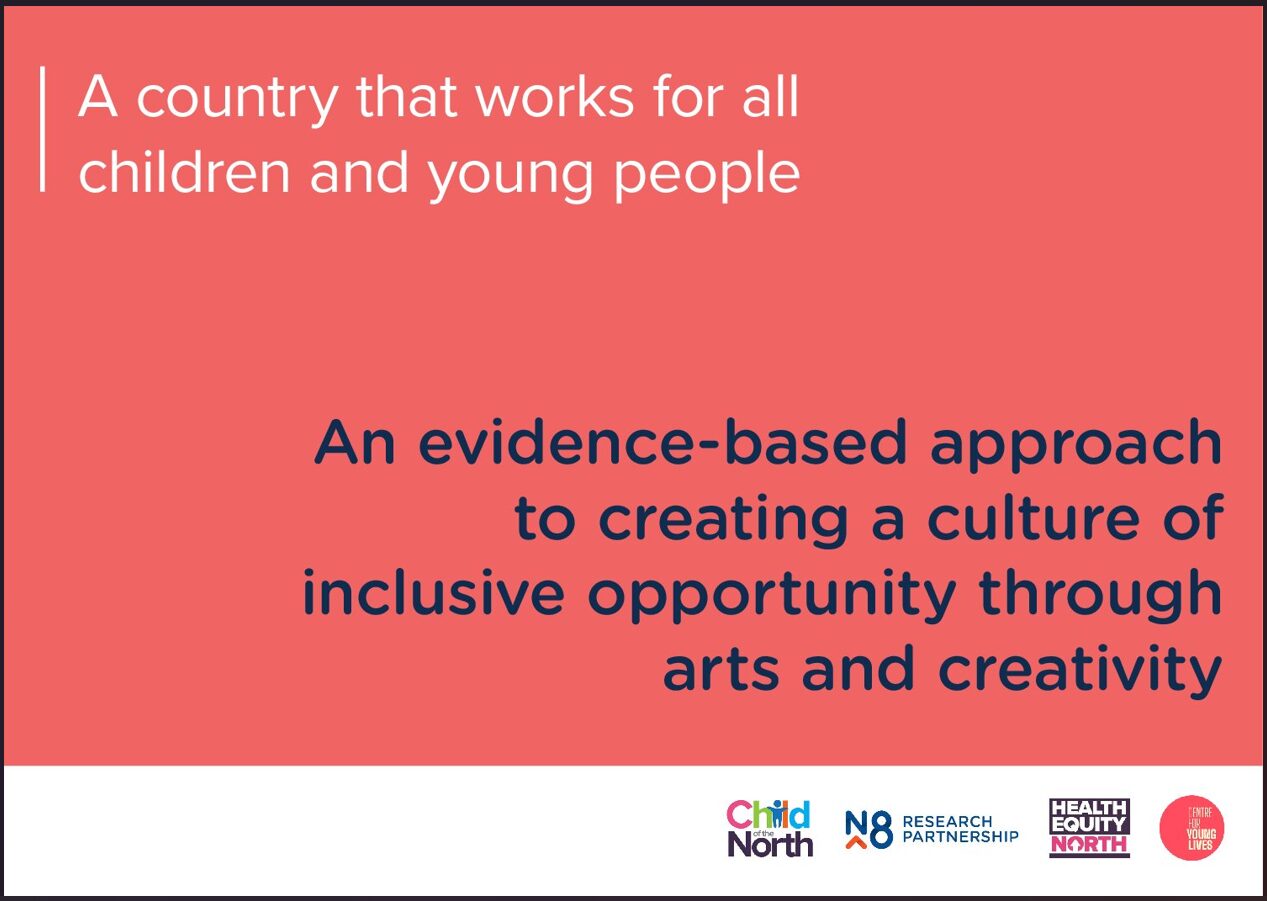 |
An evidence-based approach to creating a culture of inclusive opportunity through arts and creativityPublished March 2025 The final report in a twelve-part series – produced jointly by Child of the North and the Centre for Young Lives – that seeks to deliver a country that works for all children and young people, calls for creativity to be embedded into an inclusive school curriculum supporting all children to develop a new generation of creatives to boost economic growth. In November 2025, a report update was released alongside guidance for education colleagues, child heath colleagues and local authority colleagues. |
Principles for reform
Each report is written by researchers from the N8 universities in collaboration with a wider academic community across the North of England and beyond (the N8+) as part of the Child of the North initiative, alongside the Centre for Young Lives think tank.
The series is grounded on seven principles for reform:
- The UK government must “put children first” – The future of a country depends on a healthy workforce, equipped with the skills needed by the economy and society. Childhood determines long-term health and is the critically important period for developing the core skills needed to function within society.
- Inequity must be addressed – This will reduce the financial burden of poor population health on public services. Concurrently, economic stagnation must be reversed to generate wealth and ensure the UK makes the best use of all its assets (i.e., the brilliant young minds located across all our communities).
- Place-based approaches must be adopted – Geography, culture, economic activity, and other factors vary between localities, changing the way that support needs manifest, and the way communities prefer to engage with services. New approaches to reaching and helping families must be planned and aligned to the needs and preferences of the locality and its communities.
- Public services must work together more effectively – The needs of children and families cannot be neatly divided into silos such as “health”, “education”, “social care”, “criminal justice” etc. We must recognise that our current organisational arrangements are not fit for purpose and find new ways of delivering connected public services so that the necessary holistic (“whole system”) solutions to complex problems can be implemented.
- Education must be at the heart of public service delivery – Schools and other educational settings need to be at the epicentre of support. For example, typical “outside support” from specialist services (e.g., child and adolescent mental health services (CAMHS)) needs to be delivered within the school gates. In doing so, we start to remove the additional barriers encountered by the most disadvantaged children and reduce the burden placed on families.
- Universities must become the “Research and Development” departments for local public services – Universities can bring together insights from across multiple disciplines, ensure decisions are based on the best possible evidence, oversee evaluation of service delivery and train future health, social care, and education professionals.
- Information must be shared across public service providers and used effectively – Data are currently collected within organisational silos, which fails to reflect the reality of how families interact with services. Only by connecting our public service data can we: (i) begin to understand how services intersect and interact within families; (ii) allow the essential information sharing that will safeguard children.
Contact us
Stephen Parkinson, Research Partnership Manager